Telefunken Lido: Repair (Day 2)

Back to Part 1

Time to get inside and find out what’s wrong…
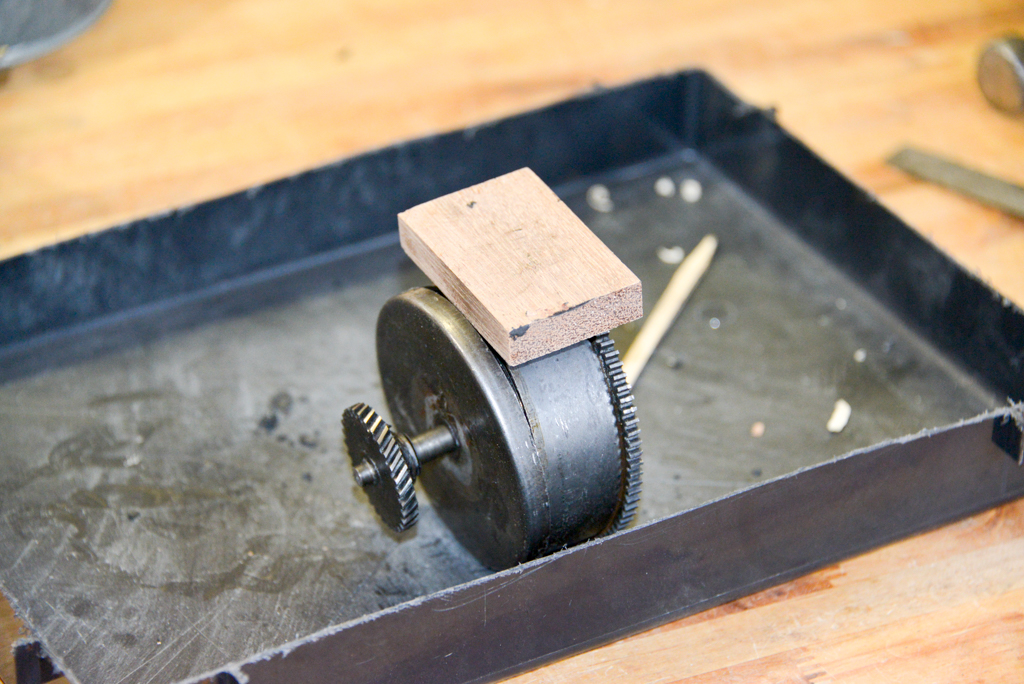
The cap comes off the mainspring barrel by tapping it with a hammer while holding onto the barrel itself. The inside shaft was already able to move up and down, so it was obvious it was no longer attached to the mainspring itself. The block of wood is used to prevent the hammer from damaging the cap edge. You hit the wood instead of the metal.

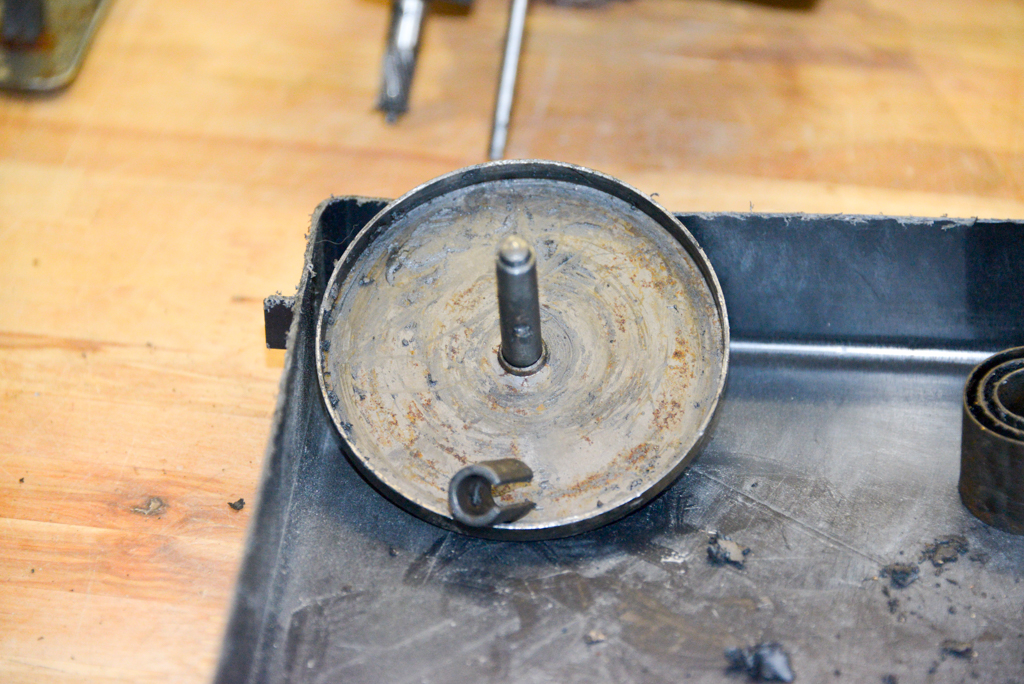
With the cap off, it’s easy to see that the mainspring is unfortunately broken. So, there are two options: Try to drill a new hole at the end of the remaining spring. This will mean heating it up to soften the steel a little… OR Try to replace it with a new spring.

A shot of the axle and the broken end of the spring. There’s a hole at the end of that spring that is caught by the hook that you can see on the axle. That hook is actually part of a sleeve that slides off the axle itself, as can be seen below.
The gap in the sleeve sits on either side of a pin that sticks out from the axle. This prevents it from rotating.

The rest of the mainspring is out of the barrel. This has to be done carefully to prevent it jumping out and either breaking something or punching a hole in me. One way to do this is to hold onto it on both sides of the barrel with two hands, and lifting one side of the spring out. This will push its way out until it gets stopped by your other hand, then you just alternate hands to let it out 180 degrees at a time. The only thing to be careful of at the end is to avoid bending the spring, since it will be caught on the pin on the inside of the barrel.

The bottom plate and the centrifugal speed regulator. The axle with the toothed gear just lifts out.

A close-up of the speed regulator and the clutch wheel, still covered in grease. Note that the pins on the end of that axle sit in brass bearings that are just holes drilled into pins. However, the holes are not centred. So, if you back off the set screws on the “front” of the vertical post, you can rotate the brass pins to change the height of the axle. Only the set screws are threaded.

The underside of the top plate. The spring that can be seen there is used to prevent the screw from rotating counter-clockwise. (Clockwise rotation loosens the spring. Counter-clockwise tightens it.) The portion that sticks out on the right is the part that the handle screws into from the outside. So, you can screw it on, tighten the spring, but then, when you reverse the rotation of the handle, it just unscrews because the rotation is stoppped by that spring grabbing the axle.
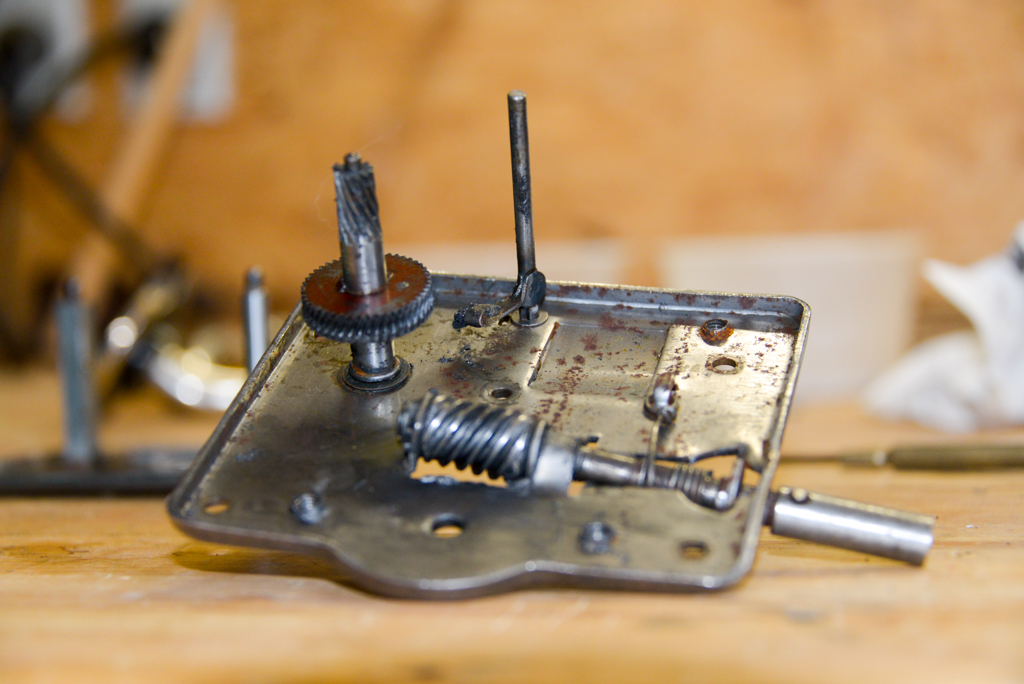
Another view of the same part. Notice the small cotten pad that sticks out of the arm connected to the tall rod in the back. That’s the part that pushes against the clutch wheel to slow things down.

The top of that same part. There’s still plenty of old grease in the worm gear… I didn’t take anything apart more than this. All of the degreasing was done in the state the you see in the photos above.

Degreasing started by just scraping off the goop with small wooden picks that I made from scraps I had lying around. The next step was to spray on WD-40 degreaser and start wiping things down with paper towels and a stiff plastic brush. That procedure was repeated until things were looking clean, but not necessarily shiny.

The photo above shows most of the bits and pieces degreased and cleaned up.
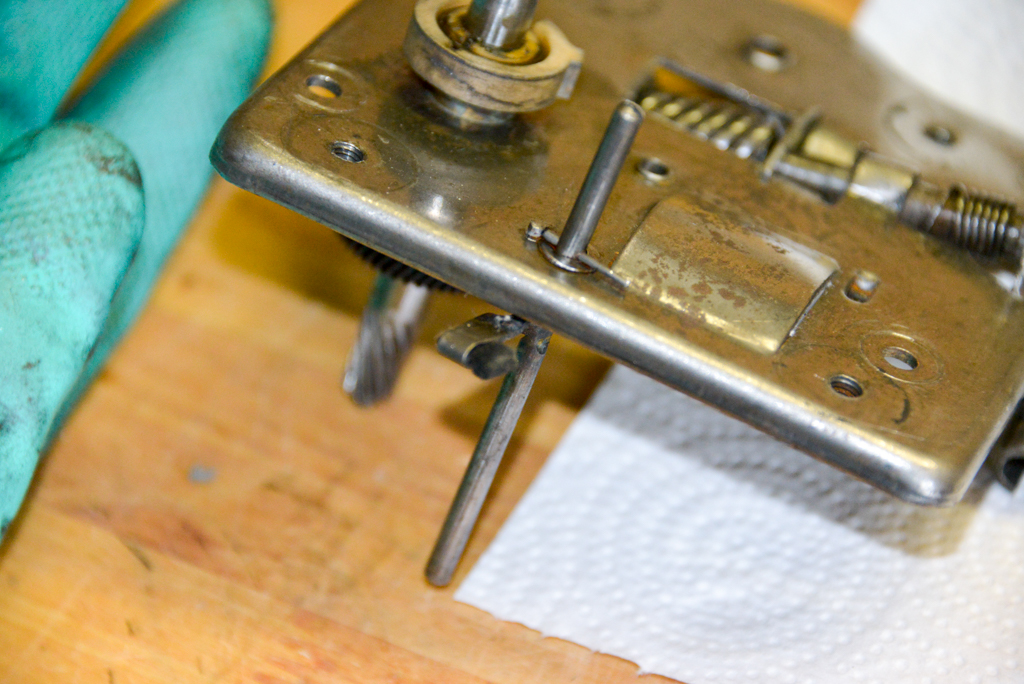
One last close-up of the cotton pad that is used for the speed regulator.

Back to the spring… I decided to not try to heat the steel, bend it to a smaller radius, and drill a new hole. Instead, I remembered that I might have some lying around. About a year or two ago, I bought a collection of tools and leftover parts from a guy who had planned to try watch and clock repair as a retirement hobby. He had bought the collection from a retired watchmaker.

In that collection, there were some old mainsprings for mantle clocks. Time to dig those out…

First thing is to measure the Telefunken’s mainspring. Turns out its roughly 23 mm wide, 0.5 mm thick, about 3.5 m long (this is just a rough estimate based on pulling it as straight as I could for as far as I could…) and the barrel interior is 78 mm in diameter. This means that I’m looking for a mainspring that’s 23 x 0.5 x 3500 x 78 – give or take…

A box of old clock mainsprings that I happened to have lying around…

I selected the spring that best matched, based on the width, and thickness and unpacked it. This is a delicate matter that involves holding the spring in a thickly gloved hand, cutting the wire, and then slowly releasing it under a towel. That way, if it does jump, you’ll only get hit in the face with a towel…

Sadly, the spring that I had on hand was too short. So, I’ve ordered one from lindholds.dk. The one that’s coming is also not as long as the original, but hopefully, it’ll do the trick.

Tomorrow: Greasing and reassambling as much of the drivetrain as I can, and starting to clean up the case.

Forward to Part 3

Telefunken Lido: Repair (Day 1)

I recently bought a well-used Telefunken Lido portable gramophone. It’s in reasonable shape, but it certainly needs quite a lot of repair and/or restoration. For starters, it doesn’t work – probably because the drive spring is either broken or disonnected inside the barrel.

The plan is to get as much fixed on it this weekend… however, that plan may change as the work progresses.

I’ve already made use of this page, this page, and this video to get ready for the project (including learning from the mistakes of others…) My documentation might be of similar use to others – in addition to providing some info on how gramophones worked…

The lido, as-is before I start…

The platter just lifts off.

The diagonal arm is the speed control that adjusts a clutch mechanism that can be seen in photos below. The needle and membrane are locked in the “travel” position, which sits them down into the mouth of the horn (the dark rectangular area at the “back”).

The first step was to unscrew the locking lid stay on the left side of the horn opening. The next step is to unscrew the lid hinges from the main case. Both the lid stay and the hinges are riveted to the lid, so they stay on.

The next step was to remove the three screws that hold the pipe + membrane + needle assembly onto the wooden top plate in the top right corner. After these have been removed, it all just lifts off.

Next is to remove the 5 small screws around the outer edge of the wood top plate. These hold the entire assembly into the bottom part of the case.

The next step is to disassemble the mechanism from the wooden top plate. In order to do this, the speed regulation arm has to be disconnected from the pin that connects it to the clutch underneath. This is done by loosening at least one of the two set screws that grab the pin.

The photo above shows the control arm after separating it from the pin that goes down into the mechanism.

Once this is done, there are four large screws the have to come out. Those are the four holes near the right-hand yellow “Fona” sticker.

In order to remote the drive mechanism, it has to be gently angled to slide it out without the spindle hitting the wood, and snaking it out around the horn.

The mechanism after removal.

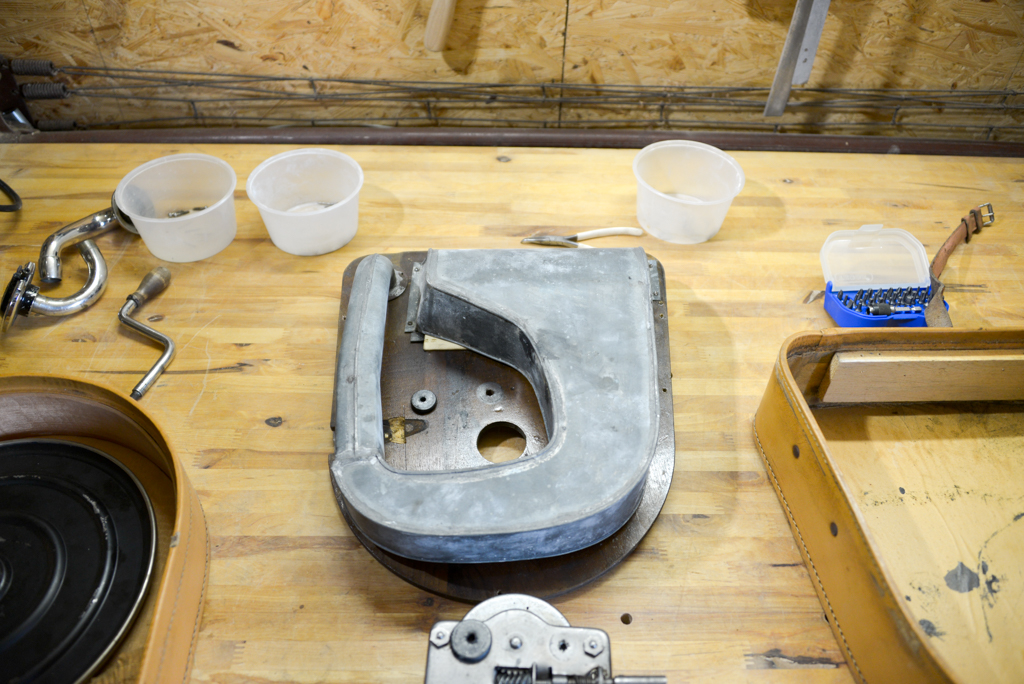
The underside of the wooden plate, showing the entire horn. This is probably made of lead by the looks of things…

The two vertical rods are the main spindle (on the left) and the clutch control (on the left). Turning the clutch control pushes a soft pad against the vertical clutch wheel that can be seen on the same axle as the centrifugal speed regulator weights.

There are four 11 mm hex nuts holding the top plate of the mechanism to the four posts. First, the rubber washers needed to be removed using a knife to separate them from the top plate. Then the four nuts are loosened and the top plate can be lifted off. This will take the clutch rod and the main spindle with it.

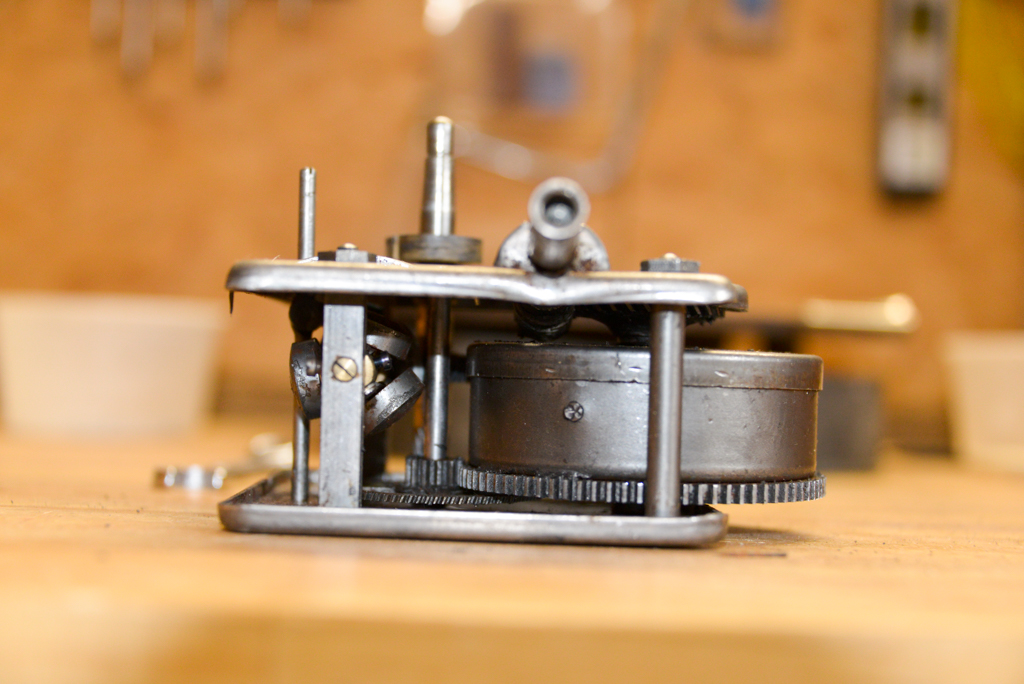
The photo above shows the bottom plate with the speed regulator and the spring barrel.

The two last photos, above, show the underside of the top plate, holding the main spindle on the left, the clutch rod in the middle, and the screw entry for the winding handle.

That’s it so far. Tomorrow will probably be spent disassembling the spring barrel and seeing whether it’s fixable. Then de-greasing and cleanup of the drive mechanism, re-greasing and re-assembly.

Forward to Part 2

Speed Math

Two math puzzles:

#1: You have to drive to a meet someone at a specific time. Let’s say that you only have to drive on one road to get there, and the speed limit is the same the whole way. You calculate the time it will take to get there on time, and you start driving – but there’s traffic. So, you wind up driving half the distance at half the speed, then the traffic disappears.

How fast do you have to go the rest of the way to arrive at the meeting on time?

#2: You’re driving on a two-lane highway where the speed limit is 70 km/h. You are driving 100 km/h, and you pull into the left lane to pass someone who is driving the speed limit. Everything about the car you’re passing is identical to yours – even the driver weighs the same as you do. At the instant that you are side-by side, a train appears across the road in front of you and stops. You both hit the brakes at exactly the same time to try and stop from hitting the train.

Luckily, the person in the other car stops just as his bumper touches the train, let’s say 1 mm before touching it… But, because you were driving faster, you cannot stop in time.

How fast are you going when you hit the train?

The answers

#1. Most people instinctively say “double the speed limit” to make up the lost time. However, this is not the right answer.

Let’s say that the meeting is 100 km away, and the speed limit is 100 km/h. Therefore, it should take you 1 hour to get to the meeting.

If you drive half the distance (50 km) at half the speed (50 km/h), then at the moment the traffic clears up, you should have been at your destination. So, you would have to drive infinity km/h to get there. However, since teleportation doesn’t exist yet, you might as well just call and tell them you’ll be late.

#2: This one is a little tougher, but it should be pretty intuitive for someone working in audio. A car’s brakes work by taking the energy in the car’s momentum, and converting that to heat in the brake discs. The key word there is energy.

So, the question is: if you consider the amount of energy removed from the car going 70 km/h, and take that out of the energy in the car going 100 km/h, how much energy is left?

The answer is 70 km/h. For someone in audio, this might look like a familiar answer, since 0.7 V has half of the power of 1.0 V (assuming identical loads). In the case of the cars, it’s because the amount of power (the amount of energy that’s transmitted over time – in this case, to heat the brakes) to bring the car from 70 km/h to 0 km/h is identical to the amount of power it takes to bring the same car from 100 km/h to 70 km/h. (An audio geek might joke that 70 km/h is 3 dB slower than 100 km/h.)

The conclusion

Slow down. You’re not going to make it to the meeting anyway, and driving a little bit faster means you’re going to hit the train much harder than you think.

Translating Q to Q

As I’ve talked about in a previous posting, when a reciprocal peak/dip filter says “Q”, there’s no knowing what it might mean, because there are at least 7 different definitions of Q (3 for boosts and 4 for dips).

For many people, this doesn’t really matter. If you’re just playing with an EQ to make things sound better right now, then the values on the display really don’t matter: it’s the sound that counts.

If you’re like me, you need to be able to navigate between different pieces of software and hardware, and to get the same EQ response from them, then you’ll also need to know firstly that you can’t trust the display, and secondly, how to “translate” from device to device when necessary.

For example, take a look at Figure 1

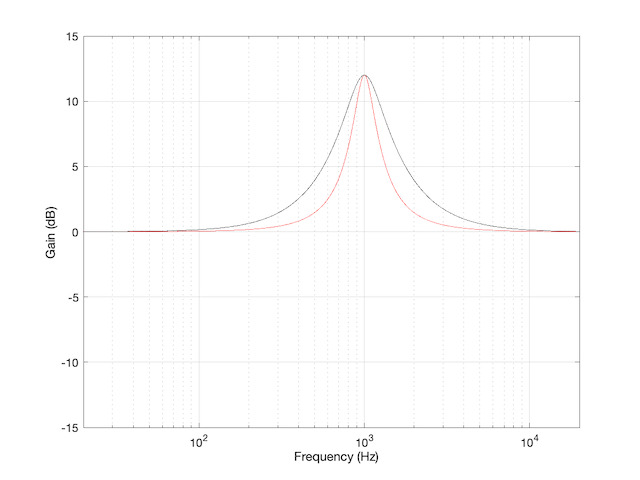
Figure 1: The magnitude response of two peaking filters, both with Fc=1 kHz, Gain = +12 dB, Q = 2

This shows two magnitude responses, however, these are the measurements of two equalisers with identical settings:
Fc = 1 kHz, Gain = +12 dB, Q = 2.

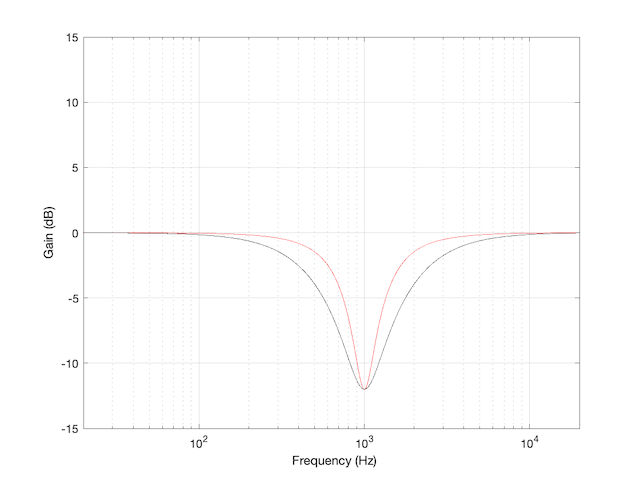
The black curve shows the response of an equaliser that uses the -3 dB points to define the bandwidth of the filter, and therefore the Q is based on 1/(2 zeta). The red curve shows the response of an equaliser that uses the mid-point (in this case, +6 dB because the Gain is +12 dB) to define the bandwidth of the filter.

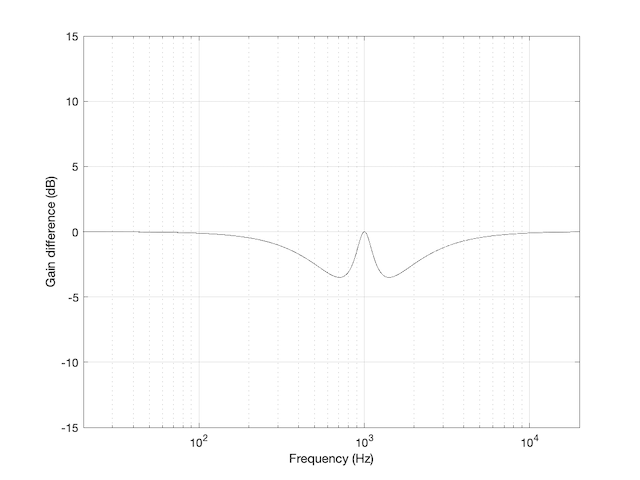
The difference between these two plots is shown below in Figure 2.

Figure 2: The difference between the two curves in Figure 1.

We’d have a similar problem if we were cutting instead of boosting, as shown in Figure 3.

Figure 3: The magnitude response of two peaking filters, both with Fc=1 kHz, Gain = -12 dB, Q = 2

You have to think upside down in this case, because the 1/(2 zeta) filter is actually using the 3 dB UP points to measure bandwidth; but we’ll ignore that and move on.

If you need to translate between the two systems shown above, there’s a pretty easy way to do it.

I’ll assume that you are implementing your filter using the mid-point definition of the bandwidth, so you need to convert into that system rather than out of it. (I’m making this assumption because it’s the one that Robert Bristow-Johnson used in his Audio Cookbook, which was freely copy-and-pasteable, which means that you find it everywhere these days.) Get the parameters from the filter you want to copy.

We’ll call these parameters Fc (for centre frequency, in Hz), G_{dB} (Gain in dB), and Q_{z}. I’m calling it Q_{z} because it’s a Q based on 1/(2 zeta) and we’ll need to keep it separate from our other Q, which I’ll call Q_{rbj} (for Robert Bristow-Johnson).

Convert the gain into linear.

    \[G_{lin} = 10^\frac{G_{dB}}{20}\]

Then do the following:

IF G_{dB} > 0

    \[Q_{rbj} = \frac {Q_{z}} {\sqrt{ G_{lin}}}\]

ELSEIF G_{dB} < 0

    \[Q_{rbj} = Q_{z} * \sqrt{ G_{lin}}\]

ELSE
your filter isn’t doing anything because G_{dB} = 0

END

Example 1

If you have a -3 dB-based filter with the following parameters:
Fc = 1.0 kHz
G_{dB} = +12 dB
Q_{z} = 2

and you want to implement that using the Bristow-Johnson equations, then you’ll have to use the following parameters:
Fc = 1.0 kHz
G_{dB} = +12 dB

    \[Q_{rbj} = \frac {2} {\sqrt{ 3.9811}} = 1.0024\]


Example 2

If you have a -3 dB-based filter with the following parameters:
Fc = 2.0 kHz
G_{dB} = -9 dB
Q = 2

and you want to implement that using the Bristow-Johnson equations, then you’ll have to use the following parameters:
Fc = 2.0 kHz
G_{dB} = -9 dB

    \[Q_{rbj} = 2 * \sqrt{ 0.3548} = 2.3826\]


Two Extra Things…

If the filter that you’re translating FROM is based on Andy Moorer’s design (which is based on the gain mid-point if the gain is within the ±6 dB range, but based on the 3 dB points if it’s outside that), then you’ll have to write your own IF/THEN statements.

If you’re implementing a filter that was specified for RBJ’s equations in a system that’s based on 1/(2 zeta), then you’re probably smart enough to figure out how to do the above in reverse.

One additional addendum

IF
you don’t like IF/THEN statements for some reason or another (code optimisation, for example)

THEN
you could do it this way instead:

    \[Q_{rbj} = \frac{Q_{z} }{ \sqrt{10^\frac{\lvert G_{dB} \rvert }{20}}}\]

What I’ve done there is to fold the decibel-to-linear conversion into the equation. I’ve also converted the gain in dB to an absolute value before converting to linear. That way, it’s always positive, so you always divide.

Q stands for…

These days, I’m spending a lot of time wrapping my head around the relationship between the frequency and the time responses of filters. In doing so, I’m digging into the concept of “Q”, of course. As a result, I’m reading my old books and some Internet sites, and I’m frequently presented with something like the following:

That, of course, is from the Wikipedia entry on “Q”.

However, in the Bell Telephone System Technical Publication – Monograph 2491, called “The Story of Q” by Estill I. Green ( published in the American Scientist, Vol 43, pp 584-594, in October 1955), it states:

“For a time, Johnson* designated the ratio of reactance to effective resistance of a coil by the symbol K. It was in 1920, while working the practical application of the wave filter which G. A. Campbell had invented some years before, that he for the first time employed the symbol Q for his parameter. His reason for choosing Q was quite simple. He says that it did not stand for ‘quality factor’ or anything else, but since the other letters of the alphabet had already been pre-empted for other purposes, Q was all he had left.”

So, if we’re going to be pedantic (which I love to be) there are two errors on that Wikipedia page. Firstly, Q does not stand for Quality. Secondly, it’s not the “Q factor”, it’s just the “Q”.

As an aside, that monograph is not only informative, it’s fun to read (depending, of course, on your definition of “fun”). For example, near the end of the paper, Green applies Q to rotating bodies (which is not a surprise, since an audio-wave oscillation is just a rotation represented in two dimensions). In that section, he points out that the rotation of the earth is slowing down due, in part, to tidal friction. Consequently, the length of a day is increasing at a rate of 0.00164 second per century, which would make the Q of the rotation of the earth equal to about 10,000,000,000,000 (10^13).

* K.S. Johnson worked in the Western Electric Company’s Engineering Department, which became Bell Telephone Laboratories in 1925.

Isn’t that super…

Rant on

I’m sick to death of the over-use of the prefix “super”, usually to amplify an adjective, in business communications. Here is a shortened list of actual examples that I’ve noticed in the recent past:

super appreciated
super challenging
super exciting
super happy
super cool
super scientific
super deep
super relevant question
super useful
super interesting
super good
super eager
super impressed
super valuable

Personally, I’m finding this to be super-annoying.

Rant off

To Rant. v.n. [randen, Dutch, to rave.] To rave in violent or high sounding language without proportionable dignity of thought.
A Dictionary of the English Language (1755)
Samuel Johnson