B&O Tech: Loudspeaker Enclosures

#105 in a series of articles about the technology behind Bang & Olufsen loudspeakers

I’ve started working with a number of my colleagues on a series of videos for internal training at Bang & Olufsen. They were kind enough to make some of these videos publicly available.

This video explains why loudspeaker drivers are typically put in enclosures (boxes), the three types of enclosures that we use (sealed, ported, and passive radiators), and the differences in impact that these enclosure types have on the loudspeaker’s behaviour.

B&O Tech: Beamforming

#103 in a series of articles about the technology behind Bang & Olufsen loudspeakers

I’ve started working with a number of my colleagues on a series of videos for internal training at Bang & Olufsen. They were kind enough to make some of these videos publicly available.

This one explains why loudspeaker drivers produce a narrower “beam” of sound at higher frequencies and how multiple loudspeaker drivers can be used to control both the direction and the width of an acoustic beam.

B&O Tech: Phantom imaging in two-channel stereo

#102 in a series of articles about the technology behind Bang & Olufsen loudspeakers

I’ve started working with a number of my colleagues on a series of videos for internal training at Bang & Olufsen. They were kind enough to make some of these videos publicly available.

This video explains (and demonstrates) how recording engineers are able to control the perceived location of different sound sources in a two-channel stereo recording using different techniques.

B&O Tech: Sound Source Localisation

#101 in a series of articles about the technology behind Bang & Olufsen loudspeakers

I’ve started working with a number of my colleagues on a series of videos for internal training at Bang & Olufsen. They were kind enough to make some of these videos publicly available.

This video explains how we are able to localise the direction of and the distance to a sound source in the real world.

B&O Tech: Human Hearing

#100 in a series of articles about the technology behind Bang & Olufsen loudspeakers

I’ve started working with a number of my colleagues on a series of videos for internal training at Bang & Olufsen. They were kind enough to make some of these videos publicly available.

This one explains some basic concepts of human hearing in the frequency domain, including how our hearing changes with level, the reason we use “loudness” processing in loudspeakers, and psychoacoustic masking.

B&O Tech: Frequency vs. Time

#99 in a series of articles about the technology behind Bang & Olufsen loudspeakers

I’ve started working with a number of my colleagues on a series of videos for internal training at Bang & Olufsen. They were kind enough to make some of these videos publicly available.

This one is an explanation of the relationship between the frequency and the time domains, and why we often do “impulse response” measurements.

B&O Tech: Basics of Sound and Acoustics

#98 in a series of articles about the technology behind Bang & Olufsen loudspeakers

I’ve started working with a number of my colleagues on a series of videos for internal training at Bang & Olufsen. They were kind enough to make some of these videos publicly available.

This first one explains the basics: how sound is produced, how it travels through air, and some of its basic measures like the speeds of sound, frequency, wavelength, amplitude, and why sound gets quieter with distance.

Symphonola Restoration: Part 1

When I was growing up in Newfoundland, we had an old gramophone in our basement that I was told, came from my great-grandfather’s house. That was about 50 years ago.

On a recent trip home from Denmark, I dismantled it and brought it back with me, with a plan to restore it. The first step was to find out what, exactly, it is, since I will have to buy some replacements for some broken or missing pieces.

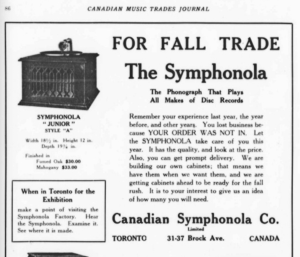
It appears to be a “Junior” model from a company called the Canadian Symphonola Co., Limited, which had a factory and headquarters at 31-37 Brock Avenue, Toronto.

This advertisement for the Junior is from the Canadian Music Trades Journal in August, 1917. Mine is the Fumed Oak variant.

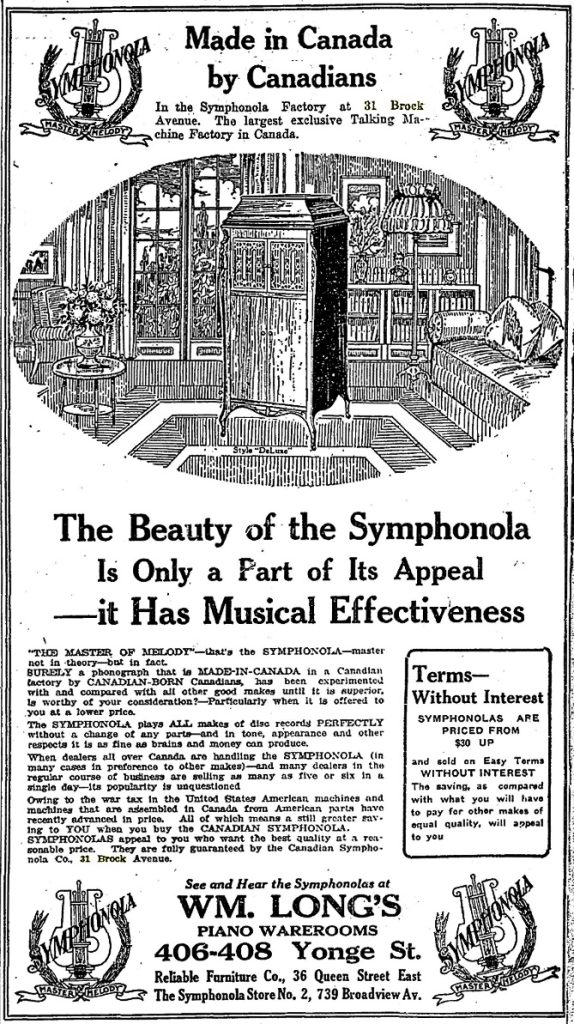
One interesting thing that I’ve come across when digging into this was this advertisement from the Toronto Daily Star in December, 1917.

The >100-year old text is weirdly familiar in these times of rather unstable international relationships. History has a tendency to rhyme.

For more information about the Symphonola company, this page at capsnews.org is a great resource. (it’s also where I found those two screenshots above…)