Stereophile
“B&O has also succeeded in using all that technology to serve the music: the BeoLab 90’s sound quality equaled the general performance of any other speaker I’ve heard, and exceeded them in the resolution and stability of the sound-stages the pair of them presented.” (Kal Rubinson)
“For now, I exhort every caring music listener to listen to the BeoLab 90 and hear what is now possible. It’s that good. (KR)
“To say how impressed with how the BeoLab 90 measured in its Narrow mode would be an understatement. This loudspeaker demonstrates just how much can be achieved with intelligent use of DSP to optimise its acoustic performance. As Kal Rubinson summed up, it is a tour de force. Wow! (John Atkinson)
Lyd og Bilde Norway
“Lyden av BeoLab 90 er vanskelig å forklare, den må egentlig bare oppleves. Personlig har jeg aldri hørt en mer livaktig musikkgjengivelse, og flere som har vært på besøk reagerte med å klype seg i armen eller felle en tåre når de hørte et opptak de kjente, eller rettere sagt trodde de kjente!”
“The sound of the BeoLab 90 is hard to explain, it must really be experienced. Personally I have never heard a more lifelike music reproduction, and several who have been visiting reacted by pinching their own arm or shedding a tear when they heard a recording they knew, or rather thought they knew!”
After Munich High End 2016
From fineartofliving.de: “Fazit: Bang & Olufsen BeoLab 90 – Die Zukunft des Klangs? Die Antwort darauf: Nach unserer Meinung zurzeit eine, wenn nicht sogar die beste Möglichkeit für optimales Klangerlebnis im High End-Bereich. Mit einer Einschränkung: Selbst angesichts des nicht minder beachtlichen Preises kann es aufgrund der hohen Nachfrage zu Lieferengpässen kommen…..
From www.hificlube.net: High End 2016 – Munich – Best Sound: Runner-up – “My colleague Martin Colloms wrote a long feature article about the Beolab 90 for Hificritic. Still I wasn’t ready for what I heard. An immersive holographic sound even when I was sitting no more than 5 feet away from the loudspeakers. Excellent focus, amazing localization of musicians and singers in the huge and deep soundstage. Maybe a hint of upper mid emphasis. To say that I am amazed is an understatement. It gets an A verging on the A+…”
Press reviews from CES 2016

soundstagehifi.com: “…this demonstration was, by far, the best I heard – and the BeoLab 90 was my favorite product – at CES 2016.”
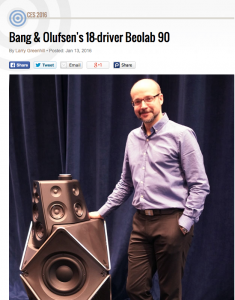
stereophile.com: “The sound was incredibly dynamic but relaxed. This was the best bass I heard at the show, and the most startlingly different soundstaging and midrange I experienced during CES 2016.
“The question I’ve been asked at every CES more often than any other is “Which sound system impressed you the most?” It’s a question that’s often difficult to answer. Typically, I’ve been impressed by several systems, often for different reasons, and it’s hard to say which was “the best.” That is, except at CES 2016. This time, I had no trouble answering this question: the BeoLab 90. The sound was utterly natural, effortless, with outstanding soundstage and imaging. I also couldn’t help but be impressed by the technology represented by this speaker system: 18 drivers of the highest quality, 18 amplifiers, full DSP control, cast aluminum enclosure. Given the components and the extensive research that went into the design of the speaker, $75,000 for the pair does not seem excessive.”

digitaltrends.com: “When we sat down for a short audition, we were gobsmacked by what we were hearing. Though we were in the very back of the room with enough people blocking our sight of the speakers that we could barely see the system, we heard a perfectly balanced presentation with the vocals seemingly coming from directly in front of us, just 2 feet away (someone’s head was in that spot).
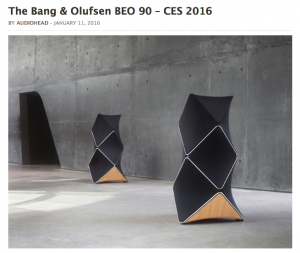
audio-head.com: “From common audiophile test tracks to a sweet spot rotation, whoever was leading the charge at the company certainly seemed vastly familiar with the hobby’s eccentric standards. The sound of the BEOLAB 90 followed in suit, the quick listening session yielded surprisingly tight image and responsive dynamic range. The bass was big, properly proportioned and beautiful in a way that reminded me of other high end rigs that play in this price range. Overall, it felt like a very impressive presentation that didn’t disappoint, checking off boxes left and right for both the audiophile and the luxury lifestyle listener.”
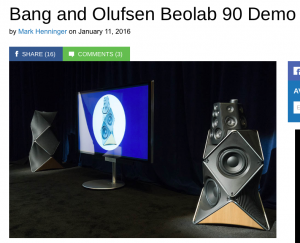
AVSforum.com: “These speakers have real guts, and yet possess more finesse than passive speakers I’ve heard that cost even more. In the rarefied price point that they occupy, Bang and Olufsen’s flagship speakers actually strike me as a bargain, as outrageous as that may sound when discussing $80,000 speakers. But, that’s exactly how good they are. Respect.”
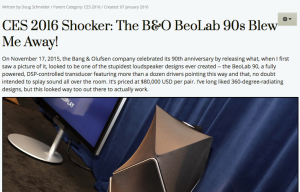
soundstageglobal.com: “what I heard from the pair at CES 2016 absolutely blew me away — the way the pair imaged, coupled with the fullness, richness, and presence exhibited, had me talking about them for the rest of the day. Now I feel a little foolish for at first thinking they were a stupid design. Don’t make the same mistake — hear a pair of 90s if you can.”

bloomberg.com: “We got a brief demo and the sound is incredible.”
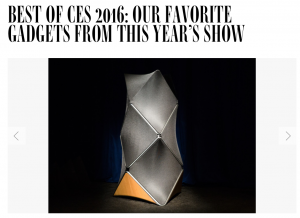
wired.com: “The soundstage is breathtaking, the low end is positively massive. Possibly the best speakers I’ve ever heard. Possibly the very speakers Crom has in his throne room in Valhalla.”
highdefdigest.com: “Having two of these exquisite pieces focused on me made for a smooth, powerful sound that will likely standout in my memory for the rest of my life. For those who can indulge, I strongly advise doing so.”
From the early press events
“So how did the BeoLab 90 make us feel? When we closed our eyes in Bang & Olufsen’s special listening room, the pair of master reference speakers (#2 and #3 ever made)—along with the room—seemed to vanish the instant a song played. We weren’t listening to sound emanating from two specific points; instead, the Weeknd was singing his heart out right in front of us. Benny Goodman’s band performed an intimate set, and you could picture where each musician was sitting. The BeoLab 90’s ability to create such a lifelike three-dimensional sound stage is unparalleled when you’re sitting in the sweet spot. It certainly brings up the question of whether a speaker can be “too” good for the music—some now-classic albums weren’t necessarily well-recorded and mastered (think of when the Rolling Stones turned the basement of a rented French mansion into a makeshift studio slash drug den). But when all the variables align perfectly, the music engulfs listeners entirely and hits the guts. The result of such incredible technology and engineering happens to be a very visceral human experience.”
“Die Abbildung war phänomenal, jedes Instrument der gewählten Musik nahm ganz selbstverständlich den für sich bestimmten Platz im Raum ein, jedes Element war von Anfang bis Ende verfolg- und erlebbar. Aber nicht nur die Ortung verblüffte, auch die Detailgenauigkeit, mit der selbst kleinste Feinheiten bis zum erkälteten Backgroundsänger aufgedeckt wurde, sucht ihresgleichen.”
– modernhifi.de
“Vi kan bevidne, at effekten er besnærende. Højttalerne spiller sammen med lytterummet på en måde, vi ikke har oplevet før. Personligt har jeg aldrig hørt et mere holografisk realistisk lydbillede, hverken i eller uden for sweet spot. BeoLab 90 er også en fuldblods, fullrange-højttaler, der ikke overlader noget til tilfældighederne.”
– lydogbillede.dk
“I found that the size of the soundstage was consistently proportional to the size of the ensemble and the recording. I found that the bass was very well extended, taut, and satisfying. Most of all, I was impressed by the prototypes’ reproduction of detail throughout the audio band, and the uniformity of that quality across the soundstage.”
– Kalman Rubinson, Stereophile magazine (print version, October, 2015)
“Wohl noch nie haben Lautsprecher die musikali schen Akteure so scharf ins Wohnzimmer projiziert. Ganz gleich, ob grosse Orchester oder kleine Jazz-Formationen – jedes ein zelne Instrument hat seinen exakten Platz im virtuellen Raum, der auch seine Tiefen dimension verblüffend genau zu erkennen gibt: Der Hörer kann zum Beispiel fast in Zentimetern abzählen, wie weit das Schlag zeug hinter dem Kontrabass placiert ist. Dass der Beolab 90 auch für schwärzeste BassTiefe, überbordende Dynamik und feinen, luftigen Obertonglanz steht, müssen TestHörer der Vollständigkeit halber natür lich ebenfalls zu Protokoll geben, aber das eigentlich Spektakuläre des Lautsprechers ist tatsächlich seine überragende räumliche Abbildung.”
– NZZ am Sonntag 18. Oktober 2015
For more comments and reviews:
How Bang & Olufsen’s BeoLab 90 Became a Reality: www.coolhunting.com
Skønheden eller udhyret? Bag om B&O BeoLab 90: www.recordere.dk
BeoLab 90: B&O laver banebrydende højttaler: www.lydogbillede.dk
Beolab 90 is Bang & Olufsen’s striking 90th anniversary speaker: www.whathifi.com
Der Traum vom Raum: Frankfurter Allgemeine
Bang & Olufsen BeoLab 90: Erster Hörtest: www.modernhifi.de
Outside the mainstream press…
diyaudio.com: “The Beolab 90 is a BEAST; I’m surprised Bang & Olufsen wasn’t kicked out of CES. I never even got close to the SPL limits of my Summas, but if the Beolab 90 had a limit, I couldn’t tell what it was. B&O cranked it up for a couple of tracks, and you could FEEL the bass. … The sound is clean and dynamic. The soundstage is whatever you give it; give it a good recording and the soundstage is pinpoint and huge, give it a crummy recording and it’s crummy. … If you couldn’t tell yet, this is the best speaker I’ve ever heard, bar none. In fact, I feel a little silly lumping it in with other loudspeakers.”
beoworld.org: I have heard a lot of powerful speakers, veeeery expensive speakers, crazy speakers and well, very much different setups. But the Beolab90 blew my mind! … The power in them, the presence of all the tones, the clarity of the sound, the smoothness, the details…. I could go on for ever. It was like I had smooth whipped butter made out of diamonds inside my ears. I will probably never again, or at least for sure not in a long time hear a speaker like this again. I will surely hear the BL90 again, but I doubt something else will beat this. It could very well be the best speaker ever made. Simple as that. Mind you, that they had only the basic software in them, so they are just getting better.”